 Add to Chrome
 Add to Firefox
 Add to Edge
ROMAN: Reward-Orchestrated Multi-Head Attention Network for Autonomous Driving System Testing
Feb 05, 2026
Automated Driving System (ADS) acts as the brain of autonomous vehicles, responsible for their safety and efficiency. Safe deployment requires thorough testing in diverse real-world scenarios and compliance with traffic laws like speed limits, signal obedience, and right-of-way rules. Violations like running red lights or speeding pose severe safety risks. However, current testing approaches face significant challenges: limited ability to generate complex and high-risk law-breaking scenarios, and failing to account for complex interactions involving multiple vehicles and critical situations. To address these challenges, we propose ROMAN, a novel scenario generation approach for ADS testing that combines a multi-head attention network with a traffic law weighting mechanism. ROMAN is designed to generate high-risk violation scenarios to enable more thorough and targeted ADS evaluation. The multi-head attention mechanism models interactions among vehicles, traffic signals, and other factors. The traffic law weighting mechanism implements a workflow that leverages an LLM-based risk weighting module to evaluate violations based on the two dimensions of severity and occurrence. We have evaluated ROMAN by testing the Baidu Apollo ADS within the CARLA simulation platform and conducting extensive experiments to measure its performance. Experimental results demonstrate that ROMAN surpassed state-of-the-art tools ABLE and LawBreaker by achieving 7.91% higher average violation count than ABLE and 55.96% higher than LawBreaker, while also maintaining greater scenario diversity. In addition, only ROMAN successfully generated violation scenarios for every clause of the input traffic laws, enabling it to identify more high-risk violations than existing approaches.

You Can Wash Better: Daily Handwashing Assessment with Smartwatches
Dec 09, 2021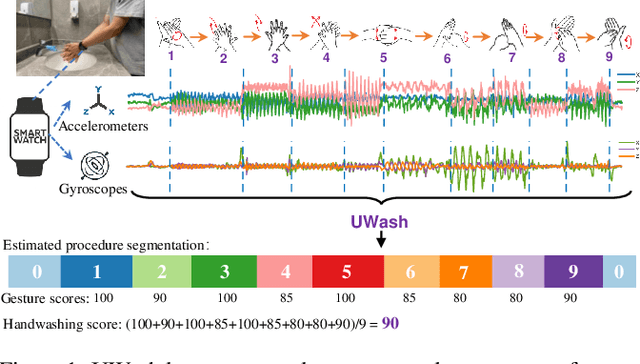
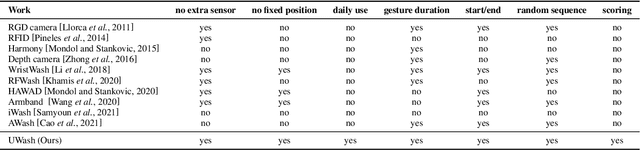
We propose UWash, an intelligent solution upon smartwatches, to assess handwashing for the purpose of raising users' awareness and cultivating habits in high-quality handwashing. UWash can identify the onset/offset of handwashing, measure the duration of each gesture, and score each gesture as well as the entire procedure in accordance with the WHO guidelines. Technically, we address the task of handwashing assessment as the semantic segmentation problem in computer vision, and propose a lightweight UNet-like network, only 496KBits, to achieve it effectively. Experiments over 51 subjects show that UWash achieves the accuracy of 92.27\% on sample-wise handwashing gesture recognition, $<$0.5 \textit{seconds} error in onset/offset detection, and $<$5 out of 100 \textit{points} error in scoring in the user-dependent setting, while remains promising in the cross-user evaluation and in the cross-user-cross-location evaluation.